Russian oil and gas companies increased E&P spendings by 38% in 2017

In 2017 Russian oil and gas companies increased investments in exploration in production by 38% to $58 billion, International Energy Agency (IEA) reported. One of the reasons for such dramatic change was the Russian rouble appreciation in 2017, but this figure also reflects growing spendings by the Russian oil and gas majors due to the oil market recovery. Thus, total investments in the Russian upstream sector counted in rubles have increased by 20% compared to 2016. IEA expects E&P investments in Russia to remain at the same level in 2018. Most of the spendings, however, will be aimed at sustaining current production at mature oilfields in Western Siberia.

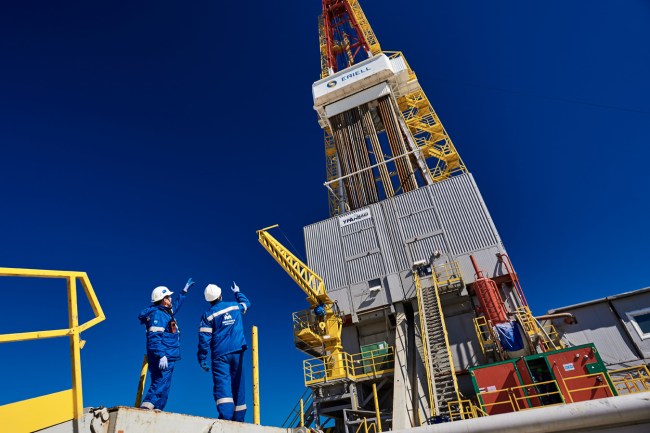
Over the last few years, Russian oil and gas companies have been actively investing in the development of new oilfields, such as Vostochno-Messoyahskoye (JV of Rosneft and Gazprom Neft), Novoportovskoye (Gazprom Neft), various oilfields of Vankor group (Rosneft), and Lukoil’s Caspian Sea shelf projects. These new projects are supposed to be a new resource base for oil production growth in the future, reports Kommersant. However, the lion’s share of the E&P investments made by Russian companies in 2017 was aimed at keeping current levels of oil production in mature Western Siberian fields. This trend is reflected by a growing number of oil wells drilled in Russia. According to Darya Kozlova, a consultant at Vygon Consulting, in 2017 there were 8,500 wells drilled in the country, a 14% increase against the number of wells drilled in 2016. At the same time, the share of hard-to-recover oil in total crude oil production in Russia exceeded 15%, while the number of horizontal wells drilled increased by 20%.
Vostochno-Messoyahskoye

Vostochno-Messoyahskoye oilfield. Image credit: Gazprom Neft

The most important objective for the Russian E&P companies in the mid-term perspective would be to develop country’s hard-to-recover oil resources, that are not economically viable under the current market conditions or due to lack of necessary technologies and equipment, said Darya Kozlova, cited by Kommersant.

The growing investments in sustaining output at mature oilfields in Russia offer great business opportunities for foreign equipment manufacturers and service providers. We at Eurasian Links expect that spending on such services as drilling (including multidirectional and horizontal drilling), well completion, hydraulic fracturing, artificial lift and other EOR methods will continue growing in the short- and mid-term perspectives. At the same time, EOR services and equipment for conventional oilfields in Russia are not affected by the U.S. and E.U. sectoral sanctions.

According to the IEA World Energy Investment 2018 report, global investment in upstream oil and gas rose by 4% to $450 billion in 2017 and is set to rise by 5% to $472 billion (in nominal terms) in 2018, driven primarily by the U.S. shale sector, which is expected to grow by around 20%. Agency also reports that “investment in conventional oil and gas remains subdued, focusing on brownfield projects, and the share of greenfield projects in total upstream investment is expected to plunge to about one-third in 2018 – the lowest level for several years.” At the same time, the global oil and gas industry is shifting towards short-cycle projects and rapidly declining producing assets while expanding into the downstream sector and petrochemicals. Most companies continue to “prioritise cost control, financial discipline and returns to shareholders. They appear to be aiming to reduce exposure to long-term risks, expanding their activities in smaller projects that generate faster payback, such as shale and brownfields.”
 

Rostec to join technology development project for Bazhenov tight oil formation

Rostec, a Russian state-controlled high-tech industrial holding, has announced its plans to explore business opportunities and participate in developing new technologies and equipment for Bazhen tight oil project in Khanty-Mansi autonomous district, reports Interfax news agency.

“Rostec is our strategic partner,” says Alexey Zabozlaev, vice-governor of Khanty-Mansi autonomous district. “We will cooperate with Rostec on several regional projects, including the development of the Arctic Urals region and the tight oil Bazhen project.”

Rostec manages a large portfolio of high-tech industrial companies operating in military, communications, transportation and other sectors. The company was set up in 2007 in order to facilitate the development, production and export of high-tech industrial products in Russia. Rostec’s portfolio includes such companies as Kamaz, Russian Helicopters, Kalashnikov Concern, High Precision Systems, United Engine Corporation and many others.

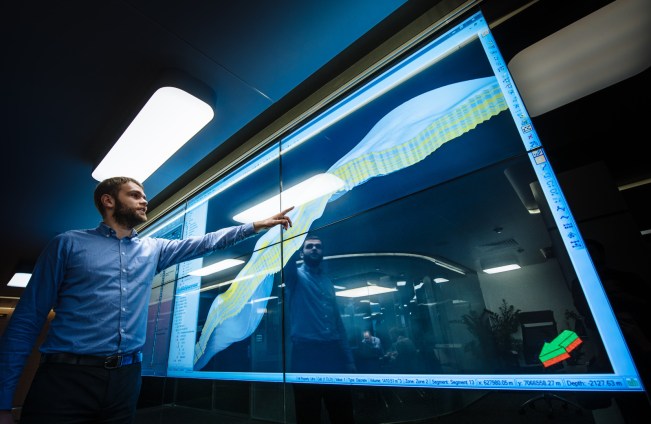
Earlier this year Gazprom Neft, a Russian oil and gas major that holds several licenses for tight oil exploration and production at Bazhenov formation, reported that by 2021 the company would invest 7.5 billion rubles (around $120 million) in R&D, aimed at developing new technologies for the project, reported TASS. Kirill Strezhnev, head of Bazhen project at Gazprom Neft, said that the dedicated enterprise, Bazhen Technological Centre Ltd., would be set up by August 2018. Under its umbrella, around 15 companies would be formed, each of them aimed at developing a particular set of technologies for the project. Gazprom Neft also invited other Russian oil and gas majors to join its R&D efforts.

tn1920x1080-NTC__39_

Gazprom Neft’s R&D centre. Image credit: Gazprom Neft

In May 2017 the Ministry of Energy of Russia granted Gazprom Neft’s project of “Developing Domestic Technologies and High-technology Equipment to Develop Reserves at the Bazhenov Formation” the status of a national project. The company intends to develop technologies for multi-stage horizontal wells construction, as well as strategies for producing light shale oil using thermochemical oil recovery method.

The “Bazhenov formation” is a geological formation in Western Siberia that covers an area of approximately one million square kilometres, running to depths of 2,000–3,000 metres. Gazprom Neft estimates oil reserves of the Bazhenov reservoir at 100–170 billion metric tonnes. The reserves of Bazhenov Formation are classified as unconventional, commonly known (even though technically incorrect) as “shale oil”.

Initially, Gazprom Neft planned to produce shale oil at Bazhenov formation jointly with Shell. However, the international major withdrew from the project in 2014 following the E.U. and the U.S. sanctions that prohibited the supply of technologies and equipment for shale oil exploration and production projects in Russia. Another international major that cancelled its participation in Bazhenov formation development was Total. In May 2014 Total and Lukoil formed a joint venture to explore for and produce tight oil on four licence blocks at Bazhenov formation that covered the area of 2700 square kilometres. However, in 2015 Total withdrew from the project due to the sanctions. According to industry analysts, Total’s participation in the project was crucial because it had hydraulic fracturing technologies needed for shale oil production. Mikhail Cherevko, the chief engineer for one of Gazprom Neft’s drilling unit, said to Financial Times that western oilfield services companies, such as Schlumberger and Halliburton, “are [also] afraid to touch the Bazhenov as if it was on fire”.

Alexey Vashkevich, exploration director at Gazprom Neft, says that the main limiting factor for the project development is the sanctions-based technology restrictions, listing kits for multi-stage fracking, pumps and well completion systems as the main equipment shortages. There is currently no Russian equipment of sufficient quality to replace western supplies. “The experience we have gained is quite positive, but we cannot go ahead with large-scale development of the Bazhenov because we are held back by the problem of equipment,” he said to FT. Industry experts agree that due to the lack of available technologies the large-scale development of the Bazhenov project will be postponed for at least five years.

However, Gazprom Neft is widely regarded by analysts as being the Russian oil company with the most advanced in-house shale technology, so the company is determined to develop resources of Bazhen alone. “It’s not a question of will we do it or not: it’s a question of time,” says Alexey Vashkevich. “It might take a little bit longer but we will get there.”

Engagement of Rostec in developing new technologies for the Bazhen reflects the importance given to domestic shale oil production by the Russian government. While production at mature conventional oilfields in Western Siberia is decreasing, development of the region’s unconventional resources would allow Russia to keep its oil production at the current level and remain one of the largest oil exporters in the world. As in the case of shelf projects, sanctions imposed by the western governments on Russian unconventional oil sector in 2014 would most likely trigger the active development of domestic technologies for shale oil production, including horizontal drilling and hydraulic fracturing. For example, import-substitution plans of the Russian government are aimed at reducing the share of foreign companies in the directional and horizontal drilling segment from 60-83% in 2014 to 40-60% in 2020. We can expect that the sanctions will halt development of tight oil resources in Russia in the short-term, however, in the mid- to long-term perspective western oilfield service companies risk to lose a significant share of the Russian market.


Chinese companies may participate in Novatek’s Arctic LNG 2 project

Chinese oil and gas companies consider participating in the new Novatek’s Arctic LNG 2 project, announced Minister of Energy of Russia Alexander Novak, cited by Interfax news agency. He explained, that Chinese involvement in Arctic LNG 2 could be similar to the one in Yamal LNG project, which is owned by Novatek (50.1%, controlling stake), French oil and gas major Total (20%), Chinese CNPC (20%) and Chinese Silk Route fund (SRF) (9,9%). Apart from this, Chinese banks provided the lion’s share of loan-based funding for the project.

Yamal2017-8

Yamal LNG project. Image credit: Novatek

As of today, two major participants of the Arctic LNG 2 project are Novatek and Total,  which has recently agreed to acquire a 10% stake in Arctic LNG 2 for $2.55 billion with the option to acquire up to 5% additionally in the case Novatek decides to decrease its share from currently planned 60%. The deal is planned to be closed in the first quarter of 2019.

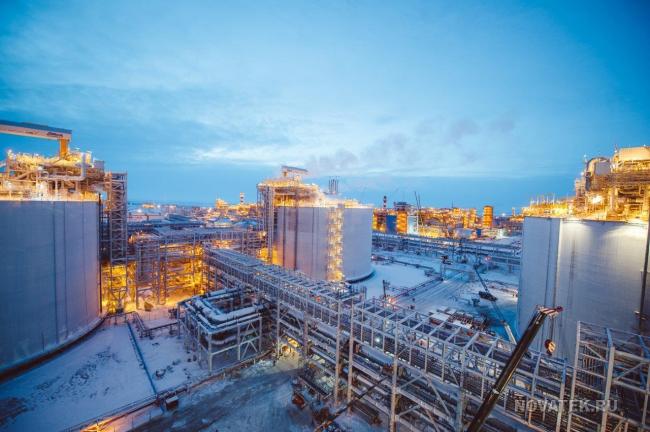
Within the framework of the Arctic LNG 2 project, Novatek plans to construct three LNG trains with a capacity of 6.6 million tonnes of liquefied natural gas per annum each. The project will use the hydrocarbon resources of the Utrenneye gas field on Gydan peninsula to the East of Yamal. Based on the Russian reserve classification, its proven reserves totaled 1,582 billion cubic meters of natural gas and 65 million tonnes of liquids. The company owns the export licence and thus would be able to sell its LNG to customers abroad. The location of the Arctic LNG 2 project in the middle of the Russian Arctic allows for geographical diversification of supplies, reaching both European and Asian customers.

Gazprom and Almaz-Antey will cooperate on oil and gas equipment import substitution

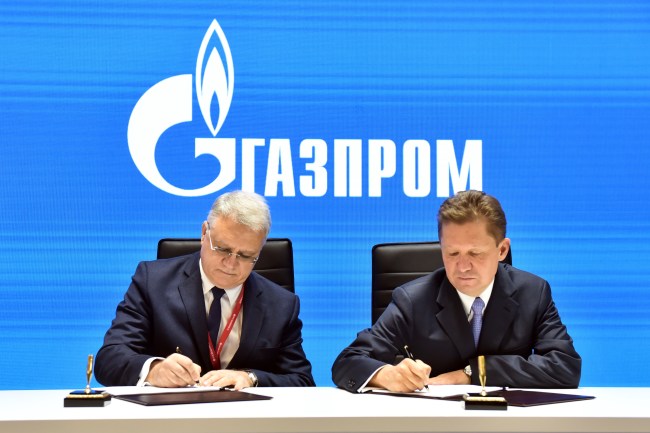
Gazprom, a state-run gas major, and Almaz-Antey, a Russian defence systems manufacturer, have signed a so-called “road map”, an action plan for cooperation in the field of high-tech oil and gas equipment development and manufacturing. The document was signed on 25 May in St. Petersburg by Chairman of Gazprom Management Committee Alexey Miller and Almaz-Antey CEO Yan Novikov.

Gaprom - Almaz-Antey

Chairman of Gazprom Management Committee Alexey Miller and Almaz-Antey CEO Yan Novikov signing the “road map”. Image credit: Gazprom

According to the document, until 2023 Almaz-Antey will develop for Gazprom high-tech equipment for offshore hydrocarbon production, gas processing and LNG production, which is currently not manufactured in Russia and is imported from abroad. All the prototypes of the new equipment will be tested and certified by Gazprom.

For designing and manufacturing of the new equipment, Almaz-Antey intends to use its manufacturing facilities in Nizhniy Novgorod, namely Nizhny Novgorod Machine-building Plant and “70 years of Victory” Plant.

Almaz-Antey is a major Russian manufacturer of military equipment, including air defence systems, missiles, firearms for aircraft and armoured vehicles, satellite communications equipment and others. Recently the company was actively seeking to expand its business into a civil field, producing various types of equipment for communications, medical, and energy industries. In 2014 Almaz-Antey was included by the U.S. in the Sectoral Sanctions Identifications List (SSI).

As we noted earlier, the sectoral sanctions, imposed by the U.S. and E.U. on the Russian oil and gas industry after the Ukrainian crisis in 2014 and prohibiting Russian companies to obtain high-tech equipment for deep offshore and shale oil projects, will eventually result in the loss of the Russian market by Western companies. Though the sanctions may negatively affect oil production in Russia in the mid-term perspective, they would also help the government and the country’s major energy companies to see that Russian oil and gas sector lacks a range of vital technologies needed to keep Russia on the list of the world’s biggest hydrocarbon producers and to sustain its ambitions of being an ‘Energy Superpower’. As the result, they will dedicate significant resources to develop their own technologies and at the same time will look for alternative suppliers in Asia. Engagement of such companies and organisations as Almaz-Amtey, Roskosmos and Rubin demonstrates significant attention Russian government pays to the import substitution in the oil and gas sector. All of the mentioned companies are well known in the international markets and have a reputation of technologically advanced companies in their respective industry sectors and market niches. As the result, in the long-term perspective European and American companies may completely lose Russian markets and, moreover, find themselves fighting for contracts with new competitors who would offer their newly developed technologies in the international markets.

Gazprom plans to acquire imported subsea equipment despite the U.S. sectoral sanctions

Gazprom, a Russian state-run energy company, plans to acquire imported subsea equipment needed for the development of its Yuzhno-Kirinskoye gas field on the Sakhalin Island continental shelf. According to Vsevolod Cherepanov, Gazprom’s board member, in 2019 the company plans to install imported flowing wellhead equipment (so-called ‘christmas tree’) onto four offshore wells. The drilling will start in mid-June 2018, but the wells will only be drilled to reach the cap of the reservoir. In 2019 Gazprom plans to acquire new subsea equipment but if this plan fails the company will continue drilling other development wells without penetrating into the reservoir, said Mr Cherepanov cited by “Kommersant” business newspaper. He also noted that the equipment for the first 8-12 development wells will be imported.

Gazprom will nevertheless have to find a way to avoid U.S. sectoral sanctions that affect Yuzhno-Kirinskoye gas field. World’s major subsea equipment manufacturers work under either the E.U. or the U.S. jurisdiction, so they would hardly agree to supply this equipment openly.

w1400_21-12-2016_shv-1

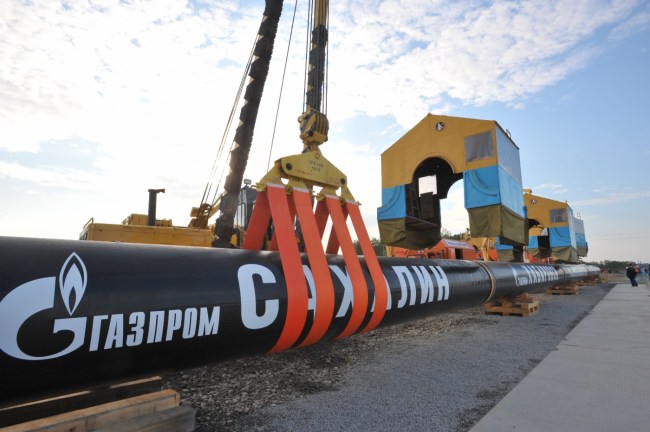
Sakhalin – Khabarovsk – Vladivostok gas pipeline. Image credit: Gazprom

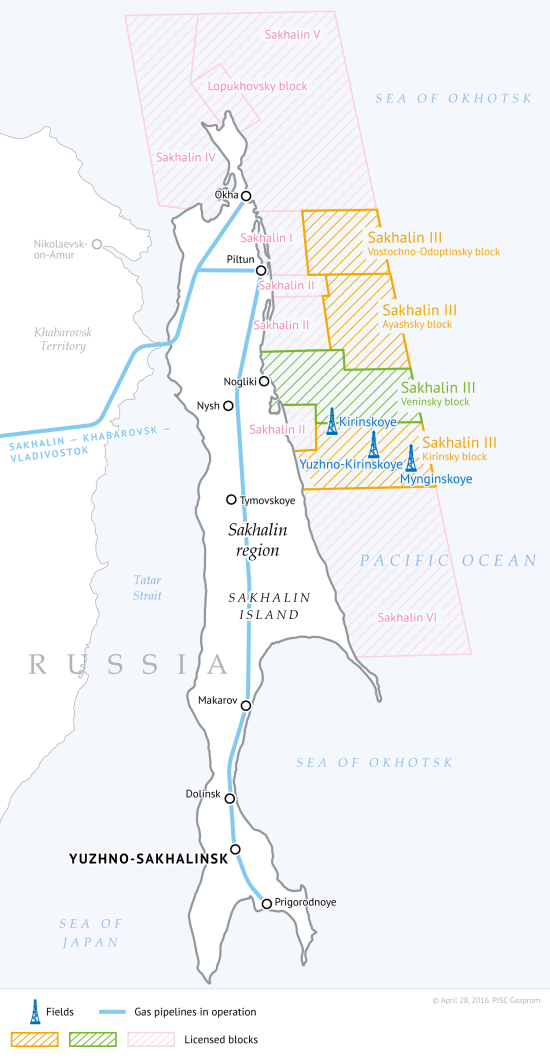
Discovered in 2010, Yuzhno-Kirinskoye gas field is one of Gazprom’s biggest offshore fields. Its recoverable reserves are estimated at 711.2 billion cubic meters of natural gas, 111.5 million metric tonnes of gas condensate, and 4.1 million tonnes of oil. It is expected that during the field development phase 37 wells will be drilled. Gas production is expected to start in 2023, reaching its planned output of 21 billion cubic meters per year in 2034. Before the sanctions were imposed in 2014, Gazprom planned to supply gas from the field as LNG in cooperation with Shell, international oil and gas major. However, in 2015 the company decided to supply gas via its Sakhalin – Khabarovsk – Vladivostok gas transmission system to customers in Russia and China.

sakhalin3-map-01-en-2016-04

Sakhalin III project map. Image credit: Gazprom

Development of Yuzhno-Kirinskoye field will require installing special subsea equipment. Apart from the flowing wellhead equipment, Gazprom would need to purchase subsea manifolds, umbilical cables, ROVs and special software. The world’s major manufacturers of this equipment are FMC Technologies (U.S.), One Subsea (Schlumberger subsidiary), GE (U.S.) and Aker Solutions (Norway). Another producer of subsea flowing wellhead equipment is Chinese MSP/Drilex, its equipment is used for the development of offshore Luhua project in China. Gazprom is currently working on developing local subsea equipment that would reduce its dependence on imports. However, it is very unlikely that Russian equipment required by Gazprom will be available in the market any time soon.

According to industry analysts, Gazprom will either have to purchase the equipment from China or develop a ‘sanctions-avoiding’ purchasing scheme with one of the European suppliers. The latter option is supposed to be more difficult since such equipment is usually produced for specific projects, making it easy for regulators to monitor and control such deals.

“Despite the U.S. sanctions, Chinese manufacturers can supply this equipment to Gazprom if it will offer attractive terms,” says Alexander Gabuev, head of the Asian program at the Carnegie Moscow Centre. “There is a proven scheme – they create a chain of companies, and if one company from this chain is affected by sanctions, a new one is then created.”

Earlier in April Deloitte, a management consulting firm, reported that Russian oilfield services companies still lack technologies required for exploration and development of offshore oil and gas fields. The main benefits from the Western sanctions on Russia got companies from China and some of the South-East Asian countries – that did not join sanctions regime – supplying equipment to Russian operators. Deloitte expects that the share of oilfield equipment imported to Russia from such countries, including China, South Korea and Singapore, will increase in the near future. For example, Chinese drilling equipment manufacturer Jereh has already created a chain of maintenance centres and storehouse facilities in Russia to optimise logistics and improve the quality of services provided to Russian customers.

We believe that, if this trend continues, Western companies may lose the Russian market due to competition from Asian companies and Russia’s strategy to develop its own technologies to substitute imports. For example, Gazprom is currently working on developing subsea equipment in cooperation with Roskosmos, Russian state exploration company, and Central Design Bureau of Marine Engineering Rubin, Russian submarine developer. In few years time Russian oil and gas majors and OFS companies may have their own equipment making Russian oilfield service sector less dependent on imported technologies. This may require Western governments to rethink their sanctions policy against Russian oil and gas sector, while the European and American oilfield services providers and equipment suppliers may have to develop new business strategies to stay in the Russian market.

Vladimir Putin appoints new members of the government responsible for oil and gas regulation

On 18 May 2018 Russian president Vladimir Putin signed a decree approving new structure and composition of the Government of the Russian Federation. The new government structure was proposed to the president by Dmitry Medvedev who was re-appointed as a Prime Minister on 8 May.

There were several changes to the Russian Government composition that affect Energy and Oil and Gas sectors.

Kozak

Dmitriy Kozak, Deputy Prime Minister. Image credit: Government of Russia

Dmitriy Kozak was appointed Deputy Prime Minister responsible for Energy and Industry sectors. During the last four years, this position was held by Arcady Dvorkovich – a close ally of Mr Medvedev – who was not invited to join the new government. According to the Russian press, Mr Dvorkovich will get a position of Director of Skolkovo Innovation Centre, a Russian venture capital and research foundation established by Dmitriy Medvedev. Mr Kozak has been working as a deputy prime minister since 2008, his last assignment was not related to energy but to the development of Crimea and Sevastopol.

Novak

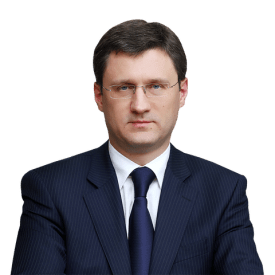
Alexander Novak, Minister of Energy. Image credit: Government of Russia

Alexander Novak was re-appointed as the Minister of Energy of Russia. According to “Kommersant” business newspaper, Mr Novak gained credibility due to effective participation of Russia in the OPEC+ deal, which allowed to increase global oil prices and thus helped to balance Russian state budget. Other achievements of Mr Novak are successful negotiations with Ukraine on energy supply to the Crimea peninsula, as well as his participation in talks with the European Commission on payments for the Russian natural gas supplied to Ukraine. Even though many Russian oil and gas companies were not particularly happy with the Ministry of Energy policy, Mr Novak was able to avoid serious conflicts with other members of the ruling elite, including influential heads of Russian oil and gas majors, such as Rosneft and Gazprom. His new supervisor will be Mr Kozak, who, according to the Russian press, has good work relations with Alexander Novak.

Kobylkin

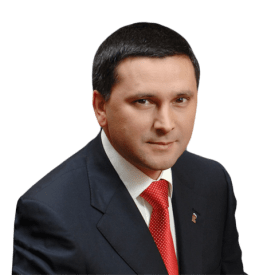
Dmitry Kobylkin,  Minister of Natural Resources and Ecology. Image credit: Government of Russia

Dmitry Kobylkin, ex-governor of Yamalo-Nenets autonomous district, was appointed new Minister of Natural Resources and Ecology. He became one of three governors who got positions in the new government. Holding a degree in geophysics, Mr Kobylkin made his career in Russian oil and gas industry before moving to the public sector in 2002. In 2010 he was appointed the governor of Yamalo-Nenets autonomous district and re-elected to this position in 2015. Yamalo-Nenets autonomous district is a region holding vast amounts of hydrocarbons, first of all, natural gas. According to the government of the district, its current proven hydrocarbon reserves consist of 44.5 trillion cubic meters of natural gas, 5 billion metric tonnes of oil and around 2 billion tonnes of gas condensate. Apart from this, the region may hold similar amount of prospective reserves, including 35 trillion cubic meters of gas and 8 billion tonnes of liquid hydrocarbons. For this reason, we do not doubt Mr Kobylkin’s knowledge and expertise in the country’s oil and gas industry regulation.

Russian Government would allow acquisition of up to 49% of EDC by Schlumberger

The Government Commission on Foreign Investments Monitoring has agreed to grant Schlumberger permission to acquire a blocking stake in the largest Russian oilfield service company Eurasia Drilling Company (EDC), said Igor Artemyev, head of the Federal Antimonopoly Service (FAS) of the Russian Federation. Schlumberger is allowed to buy up to 49% of EDC, while the sale of the controlling stake is no longer considered, reports “Kommersant” business newspaper.

“The commission has made a preliminary decision that it would not allow Schlumberger to acquire the controlling interest in EDC, which is 50% + one share. However, it would consider granting permission to buy a blocking stake, which is 25% + one share, or even 49% of the company. The Commission instructed the Federal Antimonopoly Service to hold the relevant negotiations with Schlumberger,” said Igor Artemyev cited by Interfax news agency.

edc-___________-sml

EDC rig in Russia. Image credit: EDC

Mr Artemyev also noted that sale of the blocking stake will be accompanied by a number of conditions, though less stringent than the 11 conditions that FAS previously imposed in regard to acquiring the controlling stake.

Both FAS and the Ministry of Natural Resources of Russia have pointed out, that EDC works at ‘strategic’ oilfields, and thus Schlumberger should guarantee that EDC’s business would not be affected by any possible U.S. sanctions. The Ministry of Natural Resources also insisted that Schlumberger should sell its stake in EDC to a strategic investor in the event of tightening the U.S. sanctions against Russian oil and gas sector. In March 2018 FAS reported that Schlumberger had accepted this condition.

With over 7,000 wells drilled annually, Russian drilling market remains very attractive to foreign service providers. According to industry experts, by buying a stake in EDC, Schlumberger wanted to reduce the risks of the total loss of the Russian market in case of tightening of U.S. sanctions or Russia imposing counter-sanctions on American businesses working in the country, reports “Kommersant”. In this case, the company would be able to provide at least some of its services in Russia via EDC. At the same time, the Russian government is fully aware that the Russian oil and gas industry is highly dependent on Western technologies, especially in the high-tech segment of drilling services. We believe this to some extent explains why the government took a surprisingly cooperative stance, allowing the American company to acquire a significant stake in this strategically important asset.

According to Mr Artemyev, the Commission of Foreign Investments has also asked FAS to consider Schlumberger’s offer together with the offer of the Russian Direct Investment Fund (RDIF) that plans to buy 16% of EDC. “At the moment we discuss a scenario that Schlumberger acquires 25% + one share if the company agrees to the price and other conditions. Then it is possible that RDIF and the UAE would get 16%. 25% plus 16% is a good configuration. It doesn’t give away control in the company but potentially can bring millions of dollars and even one billion of dollars,” says Igor Artemyev.

The Russian Direct Investment Fund earlier reported that the investment consortium formed to acquire a minor stake in EDC consists of the Russian-China Investment Fund (formed by RDIF and China Investment Corporation), China-Eurasian Economic Cooperation Fund (CEF) and several Middle-Eastern funds, including Mubadala from UAE.

The major shareholders of EDC are Alexander Dzhaparidzhe (about 31% of shares) and a former director of Rosneft Alexander Putilov (22.4%). The former was included in so-called ‘Putin list’ published by the U.S. Treasury Department in January 2018. Both are said to be willing to sell their stakes in EDC.